

)
)
)
Homily of Father Christopher Nkole OFM Cap for Mercy Day 2026 Mass in Baggot Street
)
Homily for Mercy Day and the Feast of Our Lady of Mercy – Thursday 24th September 2026, Catherine McAuley’s First House of Mercy, Baggot Street, Dublin
There are some places where history is remembered.
And there are other places where history is almost tangible.
This is one of those places.
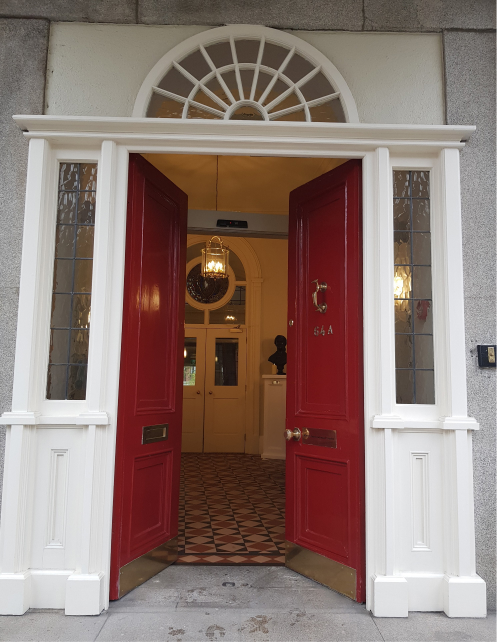
We gather today in the Chapel of the House of Mercy on Baggot Street - a place where, almost two hundred years ago, Catherine McAuley dared to believe that the Gospel could take concrete shape in the heart of Dublin.
On 24 September 1827, the House opened its doors.
It was a school for girls.
It was a home for women and girls who needed shelter.
It became a place from which the sick were visited and cared for.
And, above all, it was a place where mercy became visible.
Today, on Mercy Day 2026, we stand exactly one year from the bicentenary of that extraordinary beginning.
So perhaps the question for us this morning is not simply:
“What did Catherine do?”
But: “What does Catherine ask of us?”
1. Catherine saw what others could overlook
One of the most striking things about Catherine McAuley is that she saw.
She saw the poverty around her.
She saw women and children whose circumstances denied them dignity and opportunity.
She saw the sick, the homeless and those who had been pushed to the margins.
But seeing was not enough for Catherine.
She responded.
That is at the heart of the Mercy story.
There is a great difference between noticing suffering and allowing another person's suffering to become our concern.
Catherine crossed that distance.
She didn't simply ask, “Why doesn't somebody do something?”
She gradually came to understand:
“Perhaps I am somebody.”
And that is a profoundly Christian insight. In the Gospel of John, we hear that Mary, the mother of Jesus and our mother, saw what was missing at the wedding at Cana and did something. Jesus responded to the request of Mary and provided wine. Mary, as the disciple par excellence, was Catherine’s model of maternal mercy and compassion.
2. Catherine's great inheritance
Catherine inherited considerable resources from the Callaghans.
She could have used that inheritance to make a comfortable life for herself.
Instead, she transformed an inheritance into a mission.
She built this House.
She put resources into education, shelter and care.
The House opened on the Feast of Our Lady of Mercy, and its original purpose was remarkably practical: education for poor girls and accommodation for homeless girls and women.
Catherine's genius was perhaps that she understood something very simple:
Mercy needs somewhere to live.
Mercy needs doors that open.
Mercy needs rooms where people are welcomed.
Mercy needs classrooms.
Mercy needs beds.
Mercy needs people willing to visit the sick.
Mercy needs people prepared to get their hands dirty.
Mercy needs money - but money placed at the service of human dignity.
And ultimately, mercy needs a human heart.
That is what Catherine offered. We heard in the First Reading from Ecclesiasticus 1: 2- 11 that all is vanity. I think vanity is when resources are used for selfish and destructive ends, but the same resources become an investment in our eternal inheritance when used for the benefit of others and God’s glory.
3. The House Catherine built was never intended to be a museum.
And perhaps that is especially important as we approach 2027.
There is a danger with anniversaries.
We can become so interested in the past that we forget why the past matters.
We can admire Catherine.
We can celebrate Catherine.
We can tell stories about Catherine.
But Catherine herself would surely ask us a more uncomfortable question: Who is waiting for Mercy now?
Because the poor of 1827 are not necessarily the poor of 2026.
The needs change.
The circumstances change.
The language changes.
But the Gospel question does not change:
Do we see?
Do we care?
Do we respond?
The Sisters of Mercy describe Catherine's legacy in precisely these terms: She responded to the needs of her time, and the Mercy tradition continues to seek compassionate responses to poverty and injustice in their many forms.
So the bicentenary cannot simply be about looking backwards with gratitude.
It must also be about looking forward with courage.
4. The extraordinary courage of Catherine
There is another dimension to Catherine that deserves to be remembered.
She was not simply a kind person.
She was courageous.
She had a vision.
She had to deal with misunderstanding and criticism.
She was doing something that was unusual for a woman of her time.
And she was prepared to risk her reputation, her security and her resources because she believed that something had to be done.
There is something very contemporary about Catherine.
She did not wait until every question had been answered.
She took the next faithful step.
That connects beautifully with one of her best-known spiritual insights:
“Each day is a step we take towards Eternity.”
For Catherine, faith was not principally about having everything worked out.
It was about taking the next step.
And perhaps that is a word for us as we begin this year towards the bicentenary.
We don't know everything that Mercy will look like in another hundred years.
We don't even know exactly what the next ten years will bring.
But we can ask:
What is the next step that mercy requires of us?
5. The House and the Gospel
Whatever Gospel is proclaimed today, I would draw attention to the fact that the Gospel is not an abstract message.
Jesus repeatedly makes mercy concrete. Whatever you do to the least of my brothers and sisters, that you do unto me…….
He tells us to feed.
To welcome.
To visit.
To forgive.
To bind wounds.
To lift up.
To accompany.
To notice the person whom everyone else has stopped noticing.
And that is why this building matters. Catherine lived as a concrete good Samaritan of her time. She stopped to care for the unnoticed and avoided, those without a name and dignity in the eyes of their fellow men and women, and she did so at her own cost, like the good Samaritan of Luke 10: 25-37.
For nearly two hundred years, these walls have witnessed people trying to make the Gospel real.
People have prayed here.
Children have learned here.
Women have found shelter here.
The sick have been remembered here.
People have arrived carrying burdens - and have encountered people who were willing to carry some of those burdens with them.
That is what makes a House of Mercy.
Not the stone.
Not the architecture.
Not even the history.
The people.
6. Catherine's spirituality: trust in Providence
There is another characteristic of Catherine which I think is especially appropriate for an anniversary year: trust.
Catherine had plans, but she also had a deep trust in Providence.
She understood that the work was ultimately God's. The Psalmist tells us that, “Unless the LORD builds the house, its builders labour in vain; unless the LORD protects the city, its watchmen stand guard in vain” (Psalm 127:1).
Her famous spiritual advice about taking things “one day only” speaks of that confidence — taking “short, careful steps,” rather than demanding to see the whole road ahead.
That is particularly appropriate as we stand one year from 200 years.
A bicentenary can seem enormous.
Two hundred years of prayer.
Two hundred years of service.
Two hundred years of people responding to the Gospel.
Two hundred years of Mercy reaching across Ireland and across the world.
But Catherine might remind us:
Don't try to live 200 years today.
Live today faithfully.
Take today's step.
Do today's work of mercy.
Make today's person feel welcome.
And leave tomorrow in God's hands.
7. From 1827 to 2027
So what are we celebrating today?
Not simply a building opened in 1827.
We are celebrating a response.
Catherine saw something that was not right.
She allowed herself to be moved by it.
She trusted God.
She used what she had.
She gathered others.
She opened a door.
And something began.
The official Mercy bicentenary prayer speaks beautifully of the light that first burned here as a light of welcome, compassion and courageous love, and asks that the same trust in Providence might move us to respond to the needs of our own time.
That is a wonderful way of understanding this coming year.
We are not simply celebrating what Catherine did then.
We are asking God to give us the grace to respond now.
“Catherine saw. Catherine responded. Catherine trusted.”
She saw the needs of her time.
She responded with practical mercy.
She trusted that God would do more than she could imagine.
And perhaps that becomes our prayer:
May we see.
May we respond.
May we trust.
8. A personal word about Catherine
I think it would be lovely, in this particular Chapel, to say something personal and human about Catherine rather than presenting her only as an historical figure.
Catherine was not born knowing exactly what she would become.
She experienced bereavement.
She knew insecurity.
She knew what it was to depend upon others.
She cared for members of her own family through illness and death.
And, through her life experiences, she became increasingly attentive to the vulnerability of others. The Sisters of Mercy's account of her life describes how, after being welcomed into the Callaghan household, she devoted herself to caring for Mrs Callaghan and later Mr Callaghan, before putting her inheritance at the service of people who were poor and disadvantaged.
So perhaps Catherine's story is not simply the story of a remarkable woman.
It is the story of what God can do with an ordinary human life that remains open.
Open to compassion.
Open to interruption.
Open to people.
Open to the prompting of the Spirit.
Open to the possibility that God may be asking something more.
9. The challenge for 2026
And so, as we begin this year towards 24 September 2027, perhaps each of us might ask one simple question:
Where is mercy asking me to respond?
Not necessarily somewhere dramatic.
Perhaps in a family relationship.
Perhaps towards somebody who is lonely.
Perhaps towards somebody whose views we find difficult.
Perhaps towards a neighbour.
Perhaps towards somebody who is struggling financially.
Perhaps towards a person whose dignity has been diminished.
Perhaps towards creation.
Perhaps towards ourselves - because sometimes we need to receive mercy before we are capable of giving it.
Mercy begins with attention.
Who have I failed to see?
Mercy continues with compassion.
Whose burden can I help carry?
And mercy becomes real through action.
What can I actually do?
10. Keep the door of Mercy Open
In conclusion, one year's time, God willing, this House will be celebrating its 200th anniversary.
But the most important anniversary is not simply that a building has survived for two centuries.
The real miracle is that the spirit that animated Catherine's response continues to call people to mercy.
Catherine opened a door in 1827.
Two hundred years later, the question is:
Will we keep it open?
Open to the poor.
Open to the stranger.
Open to the sick.
Open to the young.
Open to those who feel forgotten.
Open to those whose voices are not heard.
Open to one another.
And, above all, open to God.
May this Chapel remind us that prayer and action belong together.
May this House remind us that mercy is not an idea but a way of living.
May Catherine McAuley's example remind us that one person, responding faithfully to what she saw before her, can become the beginning of something far greater than she could ever have imagined.
And as we begin this journey from Mercy Day 2026 to Mercy Day 2027, may we hear again the invitation at the heart of Catherine's life:
See what is happening.
Let your heart be moved.
Respond with mercy.
Trust in Providence.
And take the next step.
“Two hundred years ago, Catherine opened a House of Mercy. May the next chapter of that story be written not only in these walls, but in the lives of all who leave this Chapel determined to make mercy visible.”
Br. Christopher Nkole OFMCap
Acknowledgement: This homily was prepared with the huge contribution of Brenda Drumm and the Communications Department of Mercy International Ireland.
ENDS